Leukocyte Stabilization Tube
Veterinary
Flow cytometric immunophenotyping is increasingly used in veterinary research — particularly for lymphocyte subset characterization in dogs and cats. However, leukocyte surface antigens degrade during transport, making referral workflows unreliable. The Leukocyte Stabilization Tube preserves leukocyte surface antigens for up to 22 days, enabling veterinary clinics to ship samples to university laboratories for analysis without requiring on-site instrumentation.
Five core capabilities
- Membrane integrityStabilizes leukocyte membrane integrity in peripheral whole blood samples from dogs, cats, and other animal species.
- Surface antigen preservationPreserves surface antigen binding sites for downstream multicolor flow cytometric immunophenotyping — compatible with all major antibody vendors and flow cytometer platforms.
- 22-day stabilityMaintains stable leukocyte immunophenotype for up to 22 days after blood collection — room temperature (22–28°C) for Days 1–7, then refrigerated (2–8°C) through Day 22.
- Batch testingCollect multiple samples over time, analyze together — reducing inter-run instrument variability and saving laboratory time.
- Clinic-to-lab workflowEnables veterinary clinics without on-site flow cytometry to ship samples directly to a university or reference laboratory for analysis.
Veterinary research settings
The equipment and expertise required for lymphocyte immunophenotyping have traditionally been available only at university or referral centers — standardized, time-stable samples make it possible for any veterinary clinic to participate, regardless of distance from the nearest flow cytometry laboratory.
Research Laboratories
Lymphocyte immunophenotyping at veterinary schools, academic research institutions, and specialty referral laboratories.
Veterinary Research Platform
Immunophenotyping research in dogs, cats, and other animal species — T-cell, B-cell, and NK-cell subset characterization for research studies.
Remote Sample Collection
Enables veterinary clinics without on-site flow cytometry to collect and ship samples to university or reference laboratories for analysis, supporting multi-center veterinary research studies.
Workflow — 3 steps
Collect
Draw blood directly into the Leukocyte Stabilization Tube via standard veterinary venipuncture under negative pressure (draw volume 2 mL).
Mix
Immediately after collection, gently invert the tube 5 to 10 times to ensure thorough mixing of the blood with the stabilization solution. Do not shake.
Store / Analyze
Store at room temperature (22–28°C) for Days 1–7, then refrigerated (2–8°C) through Day 22. Samples remain stable for up to 22 days under these specified conditions. No cold chain required for shipping during the initial room-temperature window.
Lymphocyte subset stability over 22 days
Multiple studies using human peripheral blood (n=20) demonstrate stable multicolor flow cytometric lymphocyte immunophenotyping over 22 days. SD <1.0% across all subsets. The chemical stabilization mechanism — aldehyde-based fixation of leukocyte surface antigens — is not species-specific, and CD3/CD4/CD8/CD19/CD16/CD56 are independently validated immunophenotyping markers in veterinary research.
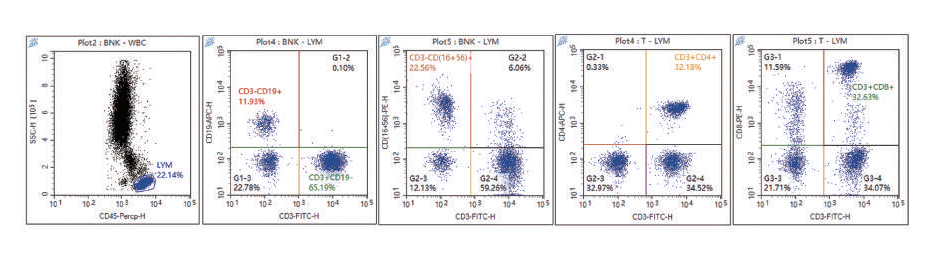
Scatter plot comparison — EDTA vs. Leukocyte Stabilization Tube
Human peripheral blood. Side-by-side multicolor flow cytometry comparing EDTA-anticoagulated blood with Leukocyte Stabilization Tube at Day 1, Day 3, Day 5, Day 7, and Day 22.
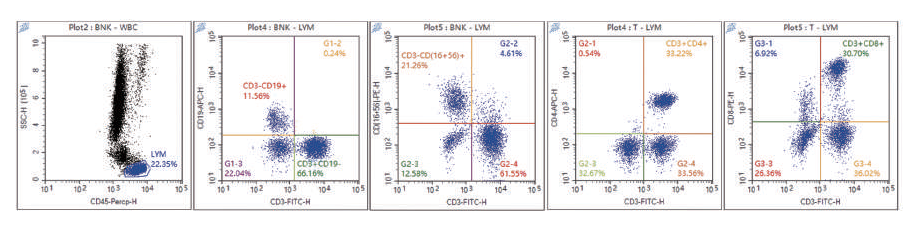
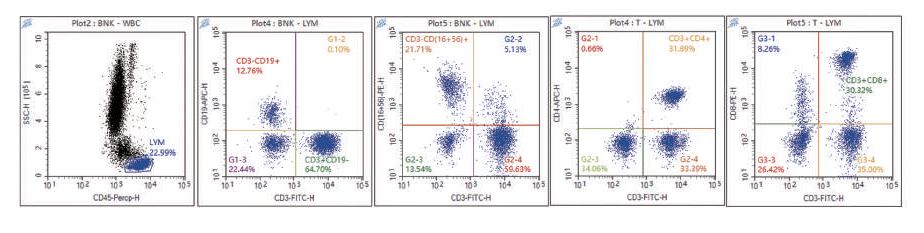
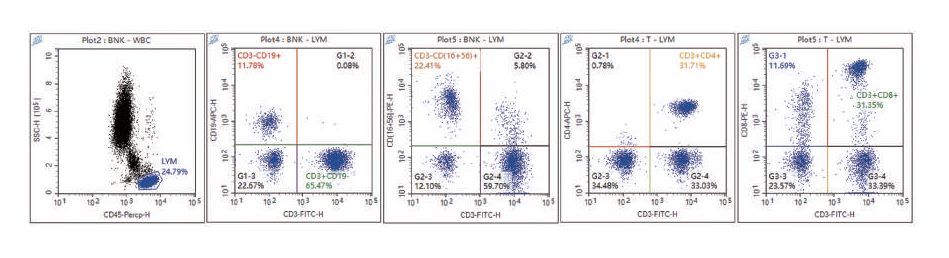
Human reference data, n=20. For Veterinary Use Only. Collaboration and validation studies in canine, feline, and other animal blood are welcomed.
- For Veterinary Use Only.
- Performance data established using human whole blood samples.
- Designed to preserve leukocyte surface antigen integrity for immunophenotyping of lymphocyte subsets (CD3, CD4, CD8, CD19, CD16/CD56). Performance for other surface markers should be validated by the user prior to use.
- The vacuum is calibrated to draw exactly 2 mL. Overfilling or underfilling will result in an incorrect blood-to-additive ratio and may lead to suboptimal performance. Do not reuse the tube.
Selected literature on veterinary leukocyte immunophenotyping
The following publications illustrate why standardized, time-stable sample handling matters for leukocyte immunophenotyping in veterinary species — background context, not data generated by IntelliFlow Tech LLC.
Common questions
Can blood be drawn directly into the tube?
Yes. The Leukocyte Stabilization Tube is designed for direct venipuncture — draw blood directly into the tube via standard veterinary venipuncture technique. No pre-collection tube or transfer device is needed.
Can I use any flow cytometer?
Yes. The Leukocyte Stabilization Tube is compatible with all major flow cytometer platforms and antibody vendors including BD Biosciences and Beckman Coulter. No special instrument settings are required.
How should filled tubes be shipped?
Filled tubes should be kept at ambient temperature (22–28°C) for Days 1–7, then transferred to refrigerated storage (2–8°C) through Day 22. Ship filled tubes according to institutional policies, carrier requirements, and applicable regulations based on the specimen risk assessment. Use leak-proof secondary containers and absorbent material.
What happens if I overfill or underfill the tube?
The vacuum is factory-calibrated to draw exactly 2 mL directly from the animal. Overfilling or underfilling changes the blood-to-additive ratio and may lead to suboptimal stabilization. Once the vacuum draw stops, do not attempt to draw additional blood.
| Product name | Leukocyte Stabilization Tube |
| Catalog number | ZK202604 |
| Format | Standard vacuum tube · laboratory-grade glass · orange cap · For Veterinary Use Only |
| Draw volume | 2 mL whole blood · direct venipuncture · blood-to-stabilization solution ratio 1:100 |
| Anticoagulant | K2EDTA (built-in) + proprietary leukocyte stabilization solution (20 µL pre-filled) |
| Dimensions | 8 ±0.5 mm OD × 75 ±2.0 mm length |
| Shelf life (unopened) | 24 months at 15–30°C (59–86°F) · Do not freeze · Protect from direct sunlight |
| Post-collection stability | Days 1–7 at 22–28°C (room temperature) · Days 8–22 at 2–8°C (refrigerated) |
| Package size | 50 tubes per pack |
| Compatibility | All major flow cytometers · BD Biosciences · Beckman Coulter · all major antibody vendors |
| Regulatory status (US) | For Veterinary Use Only |
| Labeling | English labeling · English Instructions for Use (IFU) |